The Bottom Line
I leased the 2026 Nissan Rogue SL for two weeks and ran it through pure suburban family circle. Two kids back-to-back school runs in Las Vegas heat and a Saturday that turned into five stops including a soccer field and a birthday cake. The fuel economy on a 3 cylinder engine surprised me. The Divide N Hide cargo system solved a problem that I didn’t know I had. The build quality on a $40,000 trim disappointed me in ways I’ll explain honestly. Keep reading to see how two weeks of real life changed my opinion of the most overlooked compact SUV on sale right now.
I went into this lease expecting to confirm what most people already believe about the Nissan Rogue.
Forgettable. Competent. The compact SUV you get when nothing on your list excites you enough to commit. The automotive equivalent of a perfectly acceptable Tuesday.
Two weeks later I have a more complicated opinion than that. Some of it is more positive than I expected. Some of it confirmed exactly why the Rogue gets overlooked in a class full of stronger personalities.
Here’s what actually happened.
The Three-Cylinder Nobody Trusts
The 2026 Rogue runs a 1.5-liter three-cylinder turbocharged engine. Variable compression technology, 201 horsepower, 225 pound-feet of torque.
Every time I mention a three-cylinder to someone they make a face. Like I told them the car runs on good intentions and optimism.
The engine is not the problem with this car. In two weeks of real mixed Las Vegas driving, school runs, highway stretches, stop-and-go, Saturday errands, I averaged 31 mpg. The EPA combined for the FWD version is 32 mpg. For context, that is the best fuel economy of any non-hybrid compact SUV currently on sale. Per Autoblog’s 2026 testing.
Around town the three-cylinder pulls from a stop without drama. The Variable Compression technology adjusts the engine’s compression ratio in real time based on load. What that means in practice is that at light throttle it behaves like a small efficient engine and at full throttle it finds more power than the displacement suggests.
What it does not do is feel exciting. The CVT transmission turns every acceleration into a smooth, muted, linear pull with no steps and no character. It is the powertrain equivalent of a well-run airport. Everything arrives where it’s supposed to arrive. Nobody is thrilled about the journey. Read the full story and find the valuable information ive provided.
The Saturday That Tested Everything
Two weeks of daily driving tells you a lot. But one specific Saturday told me more about the Rogue than the rest of the lease combined.
8:15am: School drop for both kids. My 8-year-old’s backpack, my 5-year-old’s backpack, one forgotten water bottle retrieved from the kitchen at the last second.
9:45am: Soccer practice pickup. Muddy shin guards. A wet towel. Both kids demanding the air conditioning be turned up because Las Vegas in late April already hits 90 degrees by mid-morning.
11:30am: Hardware store. Two bags of concrete, a box of drill bits, some PVC pipe that barely fit diagonally across the cargo area.
1:00pm: Lunch out. Parking in a tight lot near a restaurant. The Rogue’s around-view monitor showed the full perimeter of the car on the 12.3-inch screen. I parked in one move without stress.
3:15pm: Birthday cake pickup for a neighbor’s party. The cake box was wide and flat. I put it in the Divide-N-Hide lower compartment with the cargo floor raised, creating a flat surface at a height that kept the box level and stable. It didn’t slide once on the drive over.
That last detail is the Divide-N-Hide system doing exactly what it’s designed for. A configurable cargo floor that creates either a deeper well for tall items or a flat raised surface for items that need stability. It sounds like a gimmick in a brochure. It solves a real problem on a Saturday afternoon when you’re carrying a birthday cake, a bag of drill bits, and two muddy shin guards simultaneously.
What the Rear Seat Actually Does for Real Kids
My kids are 8 and 5. They have opinions about cars, which they share without being asked.
The 8-year-old’s primary concern: whether he can see the window properly from his seat. The Rogue’s rear side windows are large relative to the body and he approved immediately.
The 5-year-old’s primary concern: whether the seat feels soft. It does. The rear seat cushioning is genuinely comfortable by family SUV standards and both kids sat through a 45-minute drive without any complaints about the seats, which has not been my experience in every compact SUV I’ve reviewed.
Rear legroom comes in at 38.4 inches. That’s competitive with the class. Adults in the back on shorter trips have real room rather than the scrunched situation that some sportier crossovers create with their lower rooflines.
Car seat installation. The LATCH anchors are accessible. My daughter’s forward-facing seat went in on the first attempt without contorting my arm into an unnatural position. The rear doors open wide enough to work without the awkward half-in posture some narrower vehicles require.
The motion-activated liftgate on the SL trim was used by my kids approximately 47 times during the two-week lease. You wave your foot under the rear bumper. The liftgate opens. They found this hilarious. I found it useful when my hands were full of grocery bags.
The Fuel Economy Week
I tracked fuel economy deliberately across the second week because the first week’s numbers seemed too good to be consistent.
Monday through Friday. School runs twice daily. Two highway stretches for separate errands. One longer Saturday drive.
End of week average: 30.8 mpg. On a non-hybrid compact SUV. In Las Vegas. With the air conditioning running continuously because the alternative is a car interior that reaches 120 degrees before you finish buckling your seatbelt.
32 mpg combined EPA estimate. 30.8 mpg real-world with full family use and continuous AC in desert heat. Most compact SUVs lose more than that to real-world conditions. The Rogue’s efficient engine architecture holds up better than expected when the conditions are working against it.
Over 15,000 miles annually that fuel economy difference compared to a Rogue of five years ago saves real money. Not life-changing money. Real money that adds up across a lease period.
Where the Rogue Falls Short. Honestly.
Edmunds put this better than I can: the Rogue makes a great first impression and the overall refinement doesn’t always live up to it.
The interior materials on the SL trim don’t match the price. The SL I tested runs around $40,000 with options. At $40,000 the door panel plastics tap hollow in sections. The lower center console material shows wear patterns from daily use faster than comparable materials in the CR-V and RAV4 at similar prices. The first time I sat in the car I thought the interior looked premium. By week two I was noticing the specific places where cost-cutting showed up.
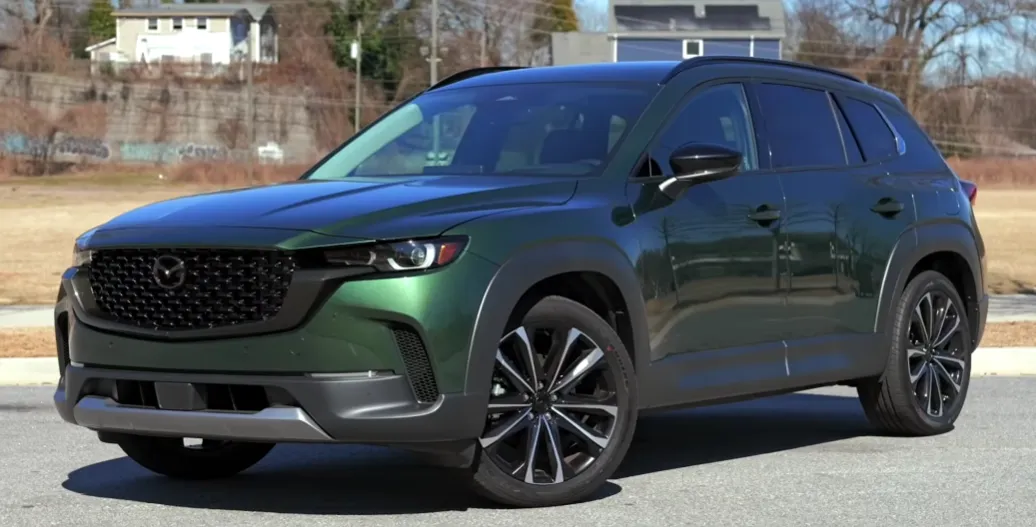
The Platinum trim at $45,000 is difficult to justify. US News tested the Platinum AWD and noted it rang in at $46,400 as tested. Edmunds called it “very pricey for what this is.” I agree. The SV at $31,180 is where the Rogue’s value argument is strongest. The Platinum pushes into territory where the Honda CR-V, the Mazda CX-50, and the Toyota RAV4 offer more compelling overall packages for the same money.
The CVT engagement issue is real and worth naming plainly. The Rogue drives smoothly and bores you slightly at the same time. It is not unpleasant. It is not involving. For buyers who want a compact SUV to disappear into the background of daily life, this is a feature. For buyers who want some feedback and personality from their daily driver, look at the Mazda CX-50 before you sign anything.
Reliability and Ownership Costs
Safety Shield 360 comes standard on every 2026 Rogue trim. Automatic emergency braking, blind spot warning, rear cross-traffic alert, lane departure warning, rear automatic braking. No trim-level negotiation required.
Nissan covers two years or 24,000 miles of scheduled maintenance on every new Rogue. Oil changes, tire rotations, and scheduled service included. That changes the real first-two-year cost of ownership in a way buyers don’t always calculate upfront.
The powertrain warranty runs 5 years or 60,000 miles. Bumper-to-bumper is 3 years or 36,000 miles.
Reliability data on the current Rogue generation is positive without being exceptional. Consumer Reports rates it average for the class. No significant mechanical patterns have emerged from owner forums on the 1.5-liter three-cylinder across real ownership. The CVT, as in most CVT-equipped vehicles, benefits from regular fluid service to maintain long-term performance.
No active recalls on the 2026 Rogue at time of writing. Verify your VIN through the NHTSA database before taking delivery.
The Myth This Two Weeks Actually Addressed
The myth about the Rogue is that it’s a nothing car. A filler purchase. The compact SUV for people who didn’t really decide, they just ended up somewhere.
That myth is partly earned and partly unfair.
Earned: the CVT, the build quality gap on upper trims, the lack of personality in the driving experience. These are real things that real buyers who care about them will notice.
Unfair: the fuel economy is genuinely class-leading for a non-hybrid. The Divide-N-Hide cargo system solves problems that other cargo floors don’t. The rear seat space is legitimately comfortable. The standard safety equipment across every trim is a real point in its favor.
The Rogue is not the most exciting compact SUV you can buy. It is one of the most practical ones. For families who spend their weeks doing exactly what I described on that Saturday, practical wins more arguments than exciting does.
Frequently Asked Questions
Which 2026 Nissan Rogue trim is the best value?
The SV at $31,180 is where most buyers should start. It adds a power-adjustable driver’s seat with lumbar support, a six-speaker stereo, and wi-fi connectivity over the base S without jumping to Rock Creek or SL pricing. US News recommends it as the sweet spot in the lineup. The Platinum at $45,000 pushes into territory where competing SUVs offer more for the money.
Is the 2026 Rogue’s three-cylinder engine reliable?
Early real-world data on the 1.5-liter VC-Turbo is positive. No systemic mechanical issues have emerged in owner forums across the current generation. The variable compression technology is more complex than a standard engine but Nissan’s engineering on this specific unit has proven durable through real ownership miles.
How is the fuel economy on the 2026 Nissan Rogue?
Best in the non-hybrid compact SUV class. EPA estimates 32 mpg combined for FWD models, 31 mpg combined for AWD. Real-world testing by Autoblog returned 31 mpg at 75 mph. In real family use with continuous AC in desert heat, I averaged 30.8 mpg across a full week. Competitors need a hybrid to match these numbers.
What is the Divide-N-Hide cargo system?
A configurable cargo floor system that lets you arrange the rear cargo area in multiple configurations. The floor adjusts to create a deeper well for tall items or a raised flat surface for stability-sensitive cargo. Standard on SV and above. More useful in real daily family use than it sounds in a spec sheet.
How does the 2026 Rogue compare to the Honda CR-V?
The CR-V has a more engaging driving experience, better interior quality on comparable trims, and stronger resale value. The Rogue has better EPA fuel economy without a hybrid, the Divide-N-Hide cargo system, and standard Safety Shield 360 across all trims. At similar prices the CR-V is the stronger overall package. The Rogue wins on fuel economy and cargo flexibility specifically.
Is the 2026 Nissan Rogue good for families with young children?
Yes. The rear seat is genuinely roomy with 38.4 inches of legroom. LATCH anchor access is easy. The motion-activated liftgate on upper trims is practically useful when your hands are full. The Divide-N-Hide system handles the variety of cargo shapes a family generates daily. The strong fuel economy keeps the weekly running cost low.