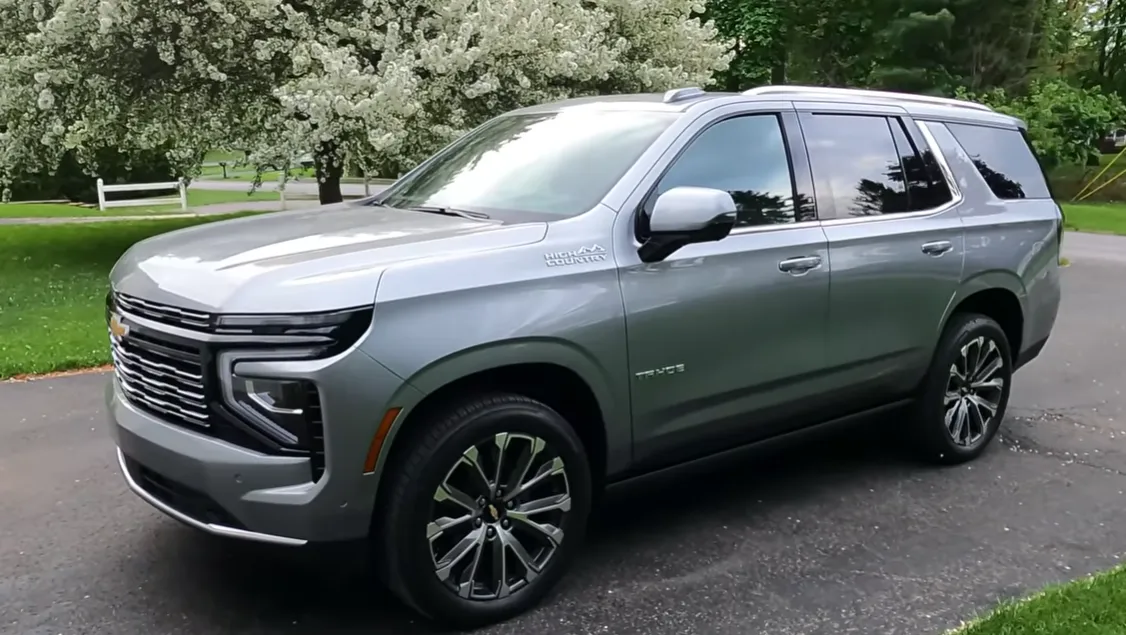
I want to tell you a story. My neighbor bought a Tahoe two years ago. Big smile on his face the day it arrived. Three months later I asked him how he liked it. He paused. Then he said “it’s great, but I didn’t think about parking it every day.”
That one sentence tells you almost everything you need to know about the Tahoe ownership experience.
It’s a big car. A really big car. And everything good and bad about it comes from that one fact.
Key Takeaways
- The 2026 Tahoe starts around $56,000 and climbs past $75,000 on the High Country trim. Budget more than you think.
- The third row actually fits adults. That’s rare in this class and it’s the Tahoe’s biggest real advantage over crossover SUVs.
- Fuel economy is genuinely bad. Around 15 to 16 mpg in real mixed driving. Plan for it.
- The ride is smooth and comfortable in a way that only body-on-frame SUVs can deliver on rough roads.
- Towing capacity goes up to 8,400 pounds properly equipped. That’s a real number for real trailers.
- Parking this thing in a city or tight lot is a daily workout. Not a dealbreaker. Just a reality.
- If you need real third row space and real towing, nothing at this price beats the Tahoe. If you don’t need both, something smaller will serve you better and cost less.
The Story Most Tahoe Reviews Skip
Here’s the thing most car reviews won’t say.
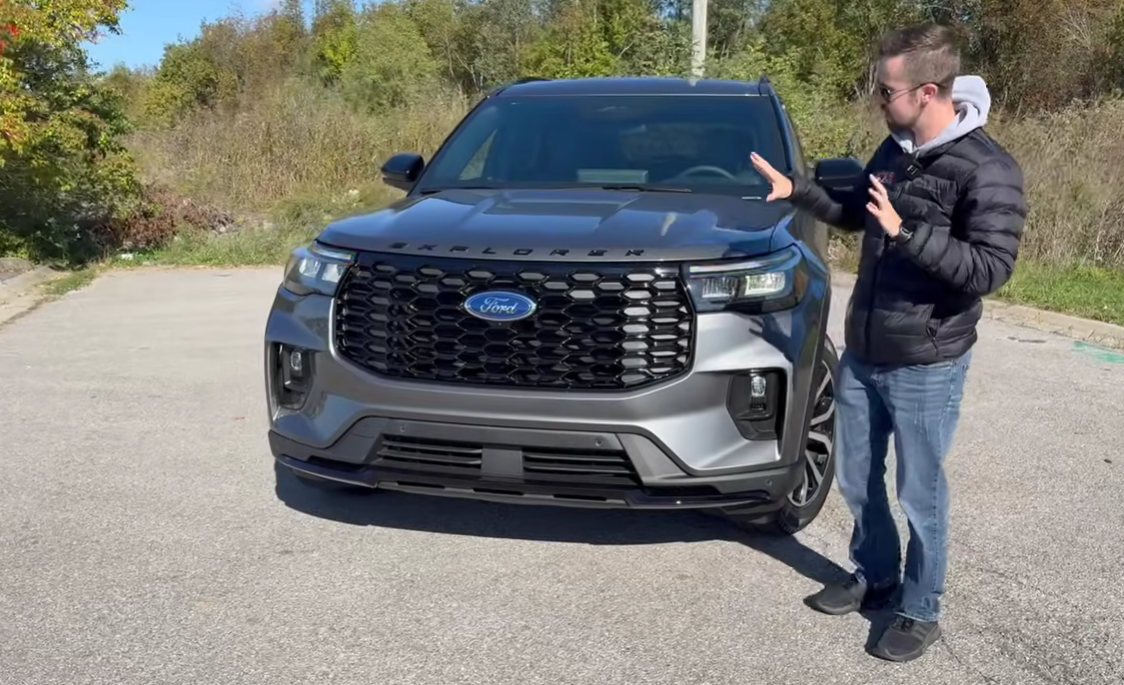
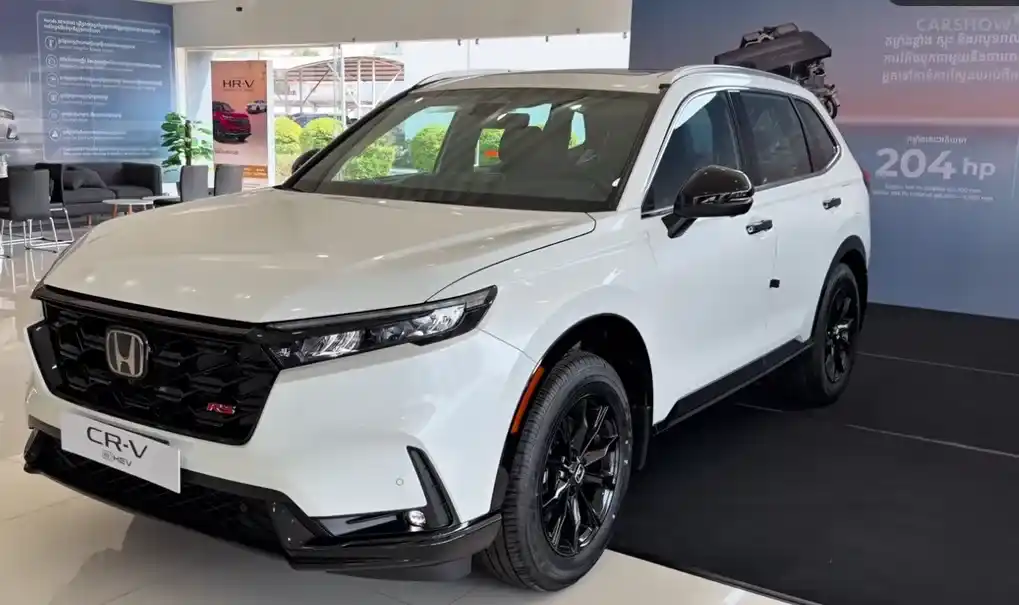
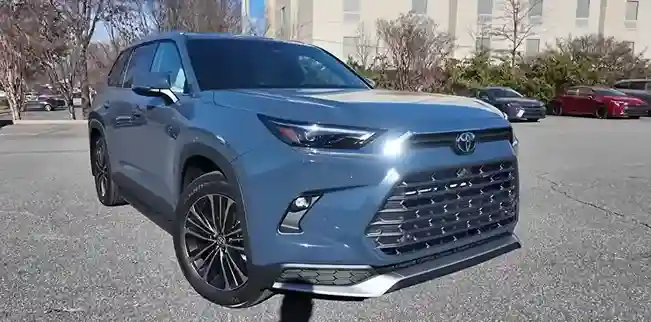
The Tahoe is not a crossover pretending to be big. It’s a truck platform wearing SUV clothes. That’s actually a compliment. But it also means it behaves differently from a Kia Telluride or a Ford Explorer in ways that matter every single day.
It rides better on bad roads. It tows way more. The third row feels like a real seat instead of a punishment.
But it also drinks fuel like it’s free. It takes up more parking space than almost anything else in its class. And it costs a lot. Really a lot.
So the question isn’t whether the Tahoe is good. It clearly is. The question is whether what it’s good at matches what you actually need.
Think about that before you keep reading.
What Does the 2026 Tahoe Actually Cost?
The starting price of $56,000 is just the beginning of the conversation.
| Trim | Starting Price | Who It’s For |
|---|---|---|
| LS | ~$56,000 | Entry point, basic features |
| LT | ~$62,000 | Best daily driver sweet spot |
| RST | ~$65,000 | Sportier look, same capability |
| Z71 | ~$67,000 | Off-road package, better for rough terrain |
| Premier | ~$70,000 | Luxury features, big jump in comfort |
| High Country | ~$75,000+ | Near luxury, loaded |
The LT is where most family buyers should start. You get the 10-inch touchscreen, wireless CarPlay, second-row captain’s chairs, power liftgate, and enough features to feel modern without paying the Premier premium.
The jump from LT to Premier is real though. Leather seats, a better sound system, and a few comfort features that actually matter on long drives. If you’re keeping this for 7 to 10 years, stretch to the Premier.
Wait. There’s something else to factor in.
Insurance on a Tahoe runs $1,700 to $2,200 per year. Fuel at 15 mpg and 15,000 miles annually costs around $3,000 to $3,500 per year. Tires for a full size SUV run $1,200 to $1,600 for a set. These are not small numbers.
The total cost of ownership on a Tahoe over five years is significantly higher than a similarly priced crossover. Not because the Tahoe is unreliable. Just because big trucks cost more to run. Source: Edmunds True Cost to Own data, 2025.
Three Weeks With the Tahoe. Here’s What Actually Happened.
Day one. I pulled out of the driveway and immediately clipped the edge of the curb turning onto my street.
Not badly. Just enough to remind me that this is not a small vehicle and muscle memory from my previous car was useless here.
By day four I had recalibrated. By day seven it felt normal.
That adjustment period is real and most reviews skip it entirely.
The first school run I did, dropping both kids off, I had to park in the street because the school lot felt too tight. The backup camera helped. The blind spot sensors helped more. But it still took more mental energy than I expected.
Here’s what happened on day two though.
I loaded both car seats, two kids, my wife, a stroller, four bags of groceries, and a soccer bag into the Tahoe and drove 45 minutes to visit family. Nobody complained once. The kids had real space. My wife had real legroom. The stroller went in without any stacking or rearranging. We got there and the kids stepped out without being cranky from being squished.
That’s the Tahoe in one moment. Slightly stressful to park. Genuinely great to live in once you’re moving.
My son sat in the third row on day five. He’s 9. He said it felt like a real seat and asked if he could sit back there every time. That tells you everything about third-row quality compared to most crossovers.
Is the Third Row Actually Usable?
Yes. Actually yes.
This is the thing that separates the Tahoe from crossover SUVs in a real way.
The Tahoe has 33.7 inches of third-row legroom. Source: Chevrolet, 2025. That’s enough for a real adult on a short trip and genuinely comfortable for kids on any trip. Most three-row crossovers, including the Ford Explorer and Kia Telluride, have third rows that adults tolerate rather than enjoy.
The Tahoe’s third row is different. Adults up to about 5’10” fit back there without constant complaining. Not luxury seating. But real seating.
Getting back there is easy too. The second-row seat tips and slides forward smoothly. One handed. Even my wife, who has strong opinions about awkward car designs, said the access was better than she expected.
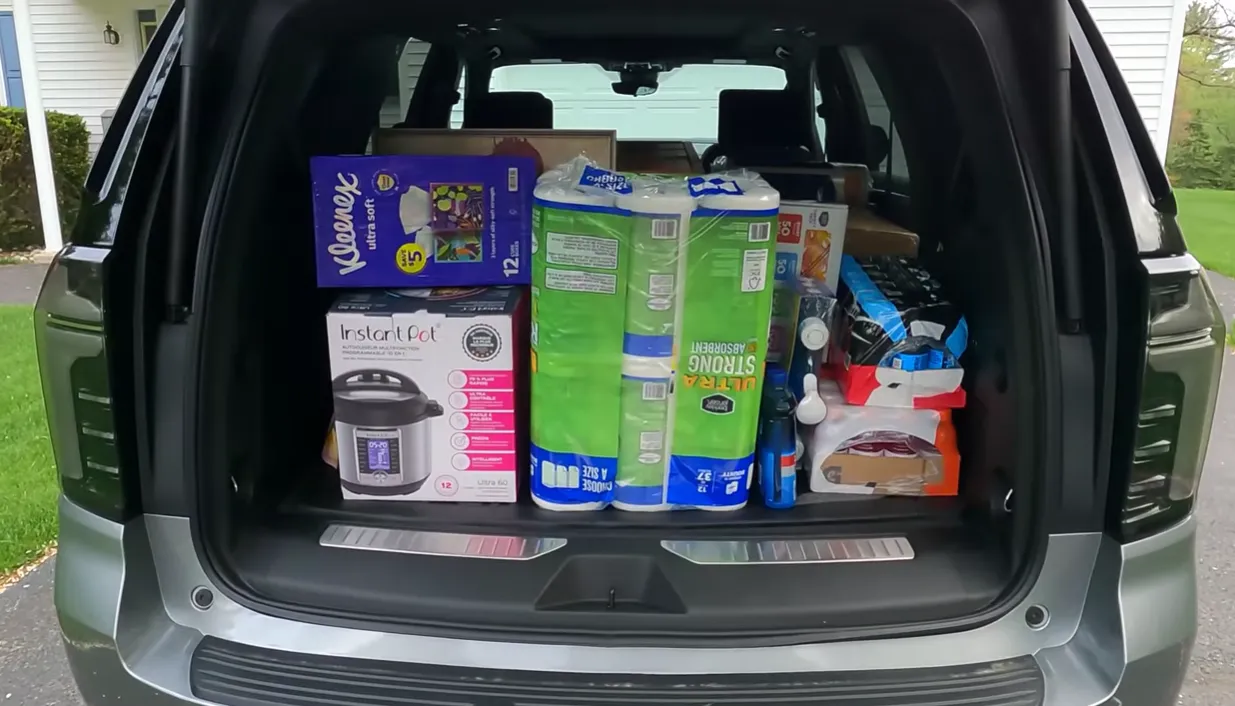
And cargo behind the third row? 25.5 cubic feet. Source: Chevrolet, 2025. That’s real space. Not just enough for two soft bags and a wish.
How Does It Feel to Drive Every Day?
Honestly better than you’d expect from something this big.
The 5.3-liter V8 makes 355 horsepower and it pulls smoothly and quietly from a stop. Zero to 60 comes in around 7.0 seconds. Source: Car and Driver, 2025. That’s not fast. But it never feels slow either. It just feels effortless.
The ride is the real story.
Body-on-frame construction with the Tahoe’s independent front suspension and multi-link rear means rough roads, speed bumps, and highway expansion joints just disappear. I drove over a badly patched road near our neighborhood that rattles every other car I’ve driven. The Tahoe absorbed it without comment.
My wife noticed it before I said anything. “This is really smooth,” she said on day three. She wasn’t expecting that from something this size.
Wind noise at 70 mph was well controlled. Not silent. But comfortable enough for easy conversation in all three rows without raising your voice.
One thing I noticed every single morning. The door. It closes with a deep, solid sound that nothing at this price does better. It sounds expensive. It sounds like something built with real material. Small detail. Stays with you.
The infotainment loaded in about 11 seconds from cold start. Wireless CarPlay connected in 12 seconds. Both are a little slower than I’d like but acceptable. The screen itself is easy to reach and read while driving.
What Tall and Short Drivers Both Need to Know
At 6’1″ I had plenty of headroom in the front. Real headroom. Not the half inch of clearance that some crossovers pass off as enough.
The sun visor covered exactly what I needed at highway sun angles. No extra squinting. No reaching for sunglasses more than usual.
For shorter drivers around 5’2″, the hood is long and high. You can’t see the front corners easily in tight parking. The front parking sensors on higher trims become very useful here. Not a dealbreaker. Just something to know.
For drivers 6’3″ and above, the front seat still works well. The second row gets tighter. The third row becomes adults-only-for-short-trips territory above that height.
The Fuel Economy Problem. Let’s Just Talk About It.
The EPA rates the 2026 Tahoe at 16 mpg city and 20 mpg highway with the 5.3-liter V8 and two-wheel drive. Source: EPA FuelEconomy.gov, 2025.
In three weeks of real mixed driving with a family load I averaged 15.4 mpg.
That’s not a surprise. It’s a big heavy V8 truck. Physics works the same on all of them.
But here’s what that actually means in dollars.
At 15,000 miles a year and current fuel prices, you’re spending roughly $3,000 to $3,500 per year just on gas. That’s $250 to $290 per month. For fuel alone.
Compare that to a Kia Telluride at 23 mpg combined. You’d save roughly $80 to $100 per month. Over five years that’s $5,000 to $6,000 in fuel savings alone.
Is the Tahoe’s extra capability worth $5,000 to $6,000 more in fuel? For some families yes. For others no. Only you can answer that honestly.
The Honest Problems With the Tahoe
Three things. No softening.
Fuel economy is a real monthly cost, not a small detail. The Tahoe drinks fuel in a way that affects your budget every single month. Not a little. A lot. If you drive 20,000 miles a year the fuel bill gets serious fast. This is not a flaw in the Tahoe. It’s physics. But it’s also not something you can paper over with “it has a great V8.”
Parking requires real adjustment. The Tahoe is 210 inches long and over 80 inches wide. Urban parking, tight lots, and narrow streets are genuinely harder than any crossover. The cameras and sensors help. They don’t solve it. If you park in tight spaces daily, be honest with yourself about whether you want to deal with this every single day.
The base infotainment feels basic for the price. The LS and LT trims come with a 10-inch screen that works fine but feels underwhelming in a $60,000-plus vehicle. The 13.4-inch screen on higher trims is significantly better. If infotainment matters to you, budget for at least the RST or Premier. Source: Consumer Reports, 2025.
How Reliable Is the 2026 Chevrolet Tahoe?
The current generation Tahoe, which launched for 2021, has a solid reliability record. Better than the generation before it.
Common owner complaints are minor. Some reports of infotainment glitches requiring a reboot. A few cases of the power liftgate responding slowly in cold weather. Occasional wind noise from door seals developing after the first year.
No major recalls active on 2026 models as of publication. Source: NHTSA recall database, 2025.
The 5.3-liter V8 is one of the most proven engines in the industry. It’s been in production in various forms for decades and the long-term reliability data on it is very strong. Most Tahoes with regular maintenance run comfortably past 200,000 miles. Source: iSeeCars longevity data, 2025.
Routine maintenance runs $500 to $700 per year for oil changes, tire rotations, and filters. Not cheap but not unreasonable for a vehicle this size.
Tahoe vs The Main Competition
| Feature | Chevy Tahoe LT | Ford Expedition XLT | Toyota Sequoia SR5 |
|---|---|---|---|
| Starting Price | ~$62,000 | ~$60,000 | ~$60,000 |
| Third Row Legroom | 33.7 inches | 34.9 inches | 35.9 inches |
| Max Towing | 8,400 lbs | 9,300 lbs | 9,000 lbs |
| Fuel Economy | 16/20 mpg | 17/22 mpg | 19/22 mpg |
| Cargo (3rd up) | 25.5 cu ft | 20.9 cu ft | 21.0 cu ft |
| Reliability | Very Good | Good | Excellent |
The Sequoia wins on reliability and fuel economy with its standard hybrid system. The Expedition wins on towing and third row legroom. The Tahoe wins on cargo space behind the third row and the overall balance of capability and comfort.
My Personal Opinion
Okay. Real talk.
I went into this lease half expecting to find a vehicle that’s more reputation than substance. A big American SUV that people buy because it’s big and American.
I was wrong.
The Tahoe genuinely earns its place. The ride quality surprised me. The third row surprised me. The towing capability is real and not just a number on a spec sheet.
But the fuel cost is also real. And the parking situation is real. And the price is very real.
Here’s who I’d tell to buy one without hesitation. You have three or more kids. You tow something regularly, a boat, a camper, a trailer. You live in a suburb or rural area where parking is never a problem. You’re keeping this vehicle for 8 to 10 years.
Here’s who I’d tell to think twice. You live in a city or dense suburb. You never tow anything. Your third row will mostly stay folded. You’re budget-conscious about running costs.
If you’re in the first group, the Tahoe is genuinely one of the best answers in the market right now.
If you’re in the second group, a Telluride or Palisade gives you 80 percent of the experience at significantly lower total cost.
Only you know which group you’re in.
Frequently Asked Questions
Is the 2026 Chevy Tahoe good for tall people? Yes for the front two rows. Drivers up to 6’3″ are comfortable up front. Second row works for most adults. Third row gets tight for anyone over 5’10” on longer trips.
How much does it cost to fill up a 2026 Tahoe? The Tahoe has a 28-gallon fuel tank. At current average fuel prices filling from empty costs around $90 to $100. At 15 mpg average you’ll fill up roughly every 400 miles.
Can the 2026 Tahoe tow a boat? Yes. Properly equipped it tows up to 8,400 pounds. That covers most boats up to about 22 to 24 feet depending on the boat and trailer weight. Always check the specific tow rating on the door jamb sticker of your exact vehicle.
Is the Tahoe or Suburban better for families? The Suburban is basically a longer Tahoe with more cargo space behind the third row. If cargo is your priority the Suburban wins. If you want something slightly easier to park the Tahoe is better. Both share the same platform and drivetrain.
How long do Chevy Tahoes last? With regular maintenance most Tahoes reach 200,000 miles without major mechanical work. Many go further. The 5.3-liter V8 has a very strong long-term track record. Source: iSeeCars, 2025.
Does the 2026 Tahoe have Apple CarPlay? Yes. Wireless Apple CarPlay and Android Auto come standard on all 2026 Tahoe trims.
Is the Tahoe worth the money over a Kia Telluride? Depends entirely on what you need. The Telluride is better on fuel economy, easier to park, costs less to buy and run, and has excellent reliability. The Tahoe beats it on towing, third row comfort, cargo space, and ride quality on rough roads. If you tow and need real third row space, Tahoe. If you don’t, Telluride.