The Bottom Line
Kyle is my cousin who bought a Volkswagen Jetta last year with my help. He called me from a dealership on a Saturday with his coworker Alex standing next to him. Alex was staring at a window sticker and had no idea what most of it meant. Kyle held the phone up and I walked them through the whole thing line by line. There are two parts of the sticker that most people miss completely and one of them can cost you real money if you do not catch it. Keep reading to find out what they are.
Kyle called me on a Saturday morning.
Kyle is my cousin. We went through the whole process of picking his first car together and I wrote about it in the Jetta review on this site.
He had his coworker Alex with him. Alex is the 23-year-old I helped with his first car search a while back, that story is in the Best First Car post on this site, and he ended up buying a Toyota Corolla Hybrid.
Now Alex was looking at a second car. Something bigger. An SUV this time. He was standing in a dealership lot and had a window sticker in front of him and Kyle said Alex had been staring at it for a few minutes trying to figure out what was what.
Kyle held the phone up toward the sticker.
I talked them through the whole thing on speaker.
Here is what I said.
What Is This Thing Anyway
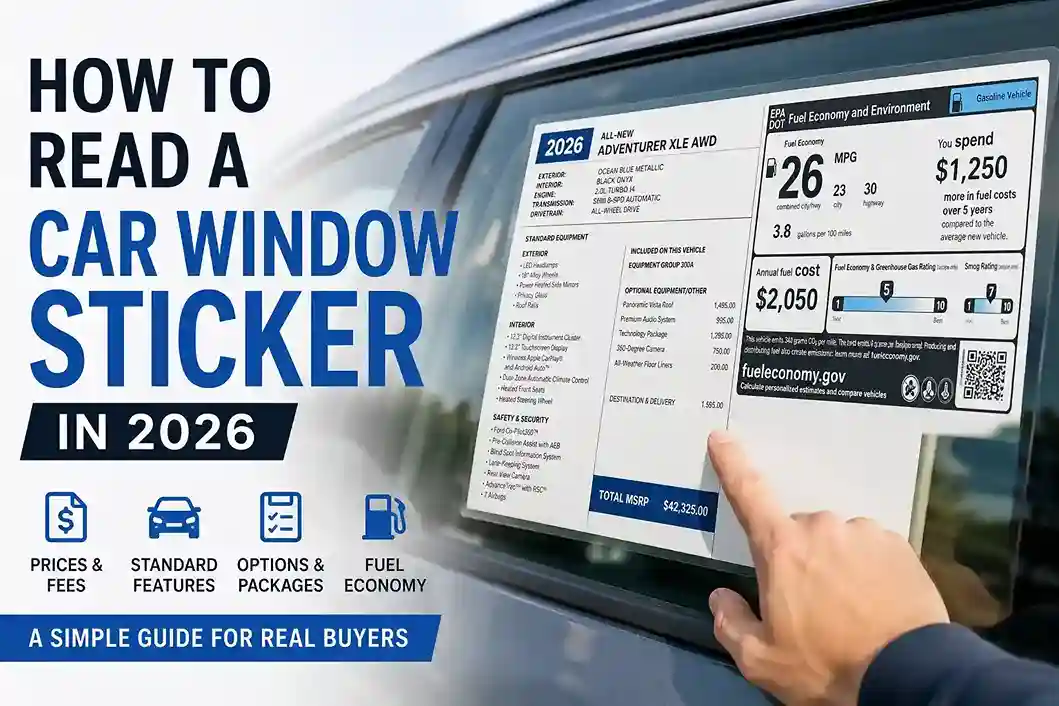
The sticker on the car window is called a Monroney label. It is named after a senator from Oklahoma who pushed for the law that made it required on every new car sold in the US back in 1958. Every new car in America has to have one by law. The dealer cannot remove it before the car is sold.
It is not a marketing flyer. It is an official document that tells you exactly what the car is, what it costs, and how it performs according to the government. Think of it as a facts page for the car.
Alex said that made sense. He had assumed it was just a price tag.
It is much more than that. Let me go through each section.
The Top of the Sticker
The very top tells you the basic facts about the car. The year, the brand, the model name, and the trim level. It also usually lists the exterior color and the interior color.
This sounds simple but check it carefully. Make sure the trim on the sticker matches the trim you think you are looking at. Sometimes a car gets moved on the lot and the sticker from a different vehicle is nearby. You want the sticker attached to the specific car you are considering to match what the salesperson has been telling you.
Also check the VIN at the top or bottom of the sticker. The VIN is a 17-character code unique to that specific vehicle. If you run the VIN on a free service like the NHTSA website later, it will show you any open recalls on that car. Always do this before you buy.
The Features List in the Middle
Below the basic info you will see a list of what comes with the car. This is split into two parts on most stickers.
The first part is the standard equipment. These are things that come on every car at this trim level no matter what. You do not pay extra for them. They are just included.
The second part is the optional equipment or packages. These are things someone ordered specifically for this car that are not on every version of this trim. Each one has a dollar amount next to it. These are add-ons that the original order included and they each add to the final price.
Alex was looking at a car with a towing package and a premium audio upgrade listed as options. I told him to add up all the option prices himself and see if those were things he actually wanted. Because the base price of the car is one number and the total with options is a higher number and sometimes the options are things you would never use.
The Price Section
Somewhere on the sticker you will see a price breakdown. It goes like this.
The base price of the car at this trim level. Then each optional package with its price. Then a destination and delivery charge. Then the total MSRP at the bottom.
The destination charge is the cost of shipping the car from the factory to the dealership. On most vehicles right now this is somewhere between $1,000 and $1,500. This charge is not negotiable. It is fixed by the manufacturer and every buyer pays the same amount. Do not waste time trying to negotiate it away because you will not win and it will frustrate both you and the salesperson.
Everything else above it can be negotiated. The base price. The optional packages. You can ask to remove optional packages from the deal or negotiate the overall price down below MSRP.
MSRP stands for Manufacturer’s Suggested Retail Price. The word suggested is important. The dealer is not required to sell at that price. On popular vehicles they sometimes charge more. On slow-selling vehicles they sometimes charge less. The MSRP is the starting point for your negotiation, not the final number.
The Fuel Economy Section
Most stickers have a large box with the EPA fuel economy numbers. City miles per gallon. Highway miles per gallon. Sometimes a combined number.
There is also usually a line showing an estimate of how much you will spend on fuel over five years compared to an average vehicle. This is a useful number for comparing two different cars side by side.
For EVs this section looks different. Instead of MPG it shows MPGe which is miles per gallon equivalent. It also shows the electric range and the cost to charge the battery.
Alex was looking at a gas SUV so this section was straightforward. City 24 and highway 31. I told him to expect the real-world number to land closer to the combined estimate which was 27, not the highway number which always looks more impressive.
The Safety Ratings Box
Most stickers include a section for NHTSA crash test ratings. These are star ratings from one to five for different types of crashes. Frontal crash. Side crash. Rollover.
Five stars is the best. Four stars is good. Anything below that on any single test is worth looking into before you buy.
Some stickers have a blank in this section. That means the specific vehicle has not been crash tested yet. This is more common with brand new models in their first year. A blank is not automatically a problem but it is a reason to check the NHTSA website yourself before committing.
The Warranty Section
Usually near the bottom or side of the sticker you will find the warranty summary. Basic bumper to bumper coverage and powertrain coverage. It lists how many years and how many miles each one covers.
This is where you can quickly compare two different brands. A Kia or Hyundai warranty covers the powertrain for ten years or 100,000 miles. A Toyota or Honda covers it for five years or 60,000 miles. That difference is right there on the sticker if you look for it.
The Two Things Most People Miss
This is the part I told Alex to pay close attention to because one of them cost him nothing and the other could have cost him real money.
The first one is the parts content section. Usually near the bottom of the sticker there is a line showing where the car was assembled and where the major parts came from. Some buyers care about this and some do not. But it is worth glancing at so you know what you are buying.
The second one is more important.
Look carefully at the window. There may be a second sticker attached next to the official Monroney label. It looks similar but it is not the same thing.
This is called a dealer addendum sticker. The dealer puts this on themselves. It lists extra things they added to the car like window tinting, fabric protection, paint sealant, a GPS tracker, VIN etching. Each one has a price. And the total at the bottom of the addendum sticker gets added to the MSRP on the official label to create the final asking price you see.
Here is the important part. Everything on the dealer addendum sticker is negotiable. Per CARFAX’s buying guide. The official Monroney label is fixed by the manufacturer. The addendum is the dealer’s additions and the dealer sets those prices themselves.
Fabric protection that costs the dealer $50 might show up on the addendum as $400. VIN etching that takes ten minutes to do might be listed as $300. These are common dealer markups on add-ons that most buyers do not question because they do not realize the two stickers are different documents with different rules.
Alex looked at the car again and found a second sticker with three add-ons totaling $1,450. I told him that entire amount was negotiable and he should ask for it to be removed before he agreed to anything.
He texted me later that day. The dealer removed all three items when he asked. $1,450 off before the real negotiation even started.
That is the whole point of knowing how to read the sticker.
Quick questions about this:
What is a Monroney label?
It is the official window sticker required by law on every new car sold in America. Named after a senator who pushed for the law in 1958. It shows the vehicle details, features, MSRP, fuel economy, safety ratings, and warranty. The dealer cannot remove it before the car is sold.
Is the price on the window sticker the price I have to pay?
No. MSRP stands for Manufacturer’s Suggested Retail Price. The word suggested means it is a starting point, not a final number. You can negotiate below MSRP on most vehicles. The only charge that is not negotiable is the destination and delivery fee which is fixed by the manufacturer.
What is a dealer addendum sticker?
A second sticker the dealer puts on the window next to the official Monroney label. It lists extra items the dealer added to the car like fabric protection, tinting, or alarm systems, with their own prices. These prices are set by the dealer and everything on the addendum sticker is negotiable. Many buyers do not realize this is a separate document with different rules.
What does the destination charge mean?
It is the cost of shipping the car from the factory to the dealership. This is a fixed charge set by the manufacturer. Every buyer of that vehicle pays the same destination charge. You cannot negotiate it away so do not waste energy trying.
What should I check on the VIN on the sticker?
Run the VIN on the NHTSA website before you buy. It takes about 30 seconds and shows any open recalls on that specific vehicle. This is free and available to anyone. Do it before you agree to anything.
What if the safety ratings section is blank?
It means the specific vehicle has not been crash tested yet by NHTSA. This sometimes happens with new models in their first year. It is not automatically a problem but you should check the NHTSA website directly to see if any ratings have been posted since the sticker was printed